Unfortunately we don't fully support your browser. If you have the option to, please upgrade to a newer version or use Mozilla Firefox, Microsoft Edge, Google Chrome, or Safari 14 or newer. If you are unable to, and need support, please send us your feedback.
Future ready: Elsevier's AI in higher education newsletter
In this issue, we look ahead at how AI might reshape the research enterprise in priority areas like innovation and real-world impact.February 2026
Introducing LeapSpace - research-grade AI
AI adoption among researchers is high, but trust lags behind. While 84% of researchers say they have used AI tools for work or other purposes, only 22% believe they are trustworthy.1 This gap in credibility highlights a critical challenge with current AI tools. LeapSpace, a publisher-neutral AI-assisted workspace built for research, has been designed to fill that gap.
More innovative and impactful research – can AI help?
Academic publishing levels have reached record highs, yet questions persist about research relevance and impact. Is the decline of “disruptive” research part of the problem – and, if so, can AI help by broadening the frame of reference and highlighting new connections?
Boom or bust?
From a historical perspective, academic research is experiencing an unprecedented boom. More research articles are being published, with estimates ranging from just over 5 million to more than 7 million publications annually, including reviews, surveys and conference proceedings. There are also more researchers than ever before. UNESCO reports a 13.7% increase in the number of researchers between 2014 and 2018, a rate “roughly three times faster than the growth rate of the global population during the same period.” Other measures confirm this upward trend. Global patent applications have almost doubled since 2010, rising from just under 2 million to 3.7 million in 2024. More skilled people are systematically gathering and interpreting evidence to test ideas and solve problems than ever before in human history.
Despite this frenzy of intellectual activity, there are significant caveats. Increased research output does not guarantee consistent high quality nor equal disciplinary coverage. Humanities subjects often slip under the radar altogether because of their focus on publishing in books rather than journal articles. At the same time, the large volume of new research has exacerbated the challenge of information overload for scholars across all disciplines. The phenomenon is variously attributed to the publish-or-perish culture in universities, the rise of Open Access mega journals, and the rapid growth of newer research nations like India and China.
Finding the right ideas for growth
Given this extraordinary productivity, why are so many universities still grappling with a perceived loss of trust and relevance in society? Indeed, if, as economists like the Nobel Laureate Paul Romer maintain, "non rivalrous" ideas (i.e., capable of simultaneous use by many people) are key drivers of long-term economic growth, why aren’t we seeing a prolonged uptick in prosperity in the world’s leading research nations?
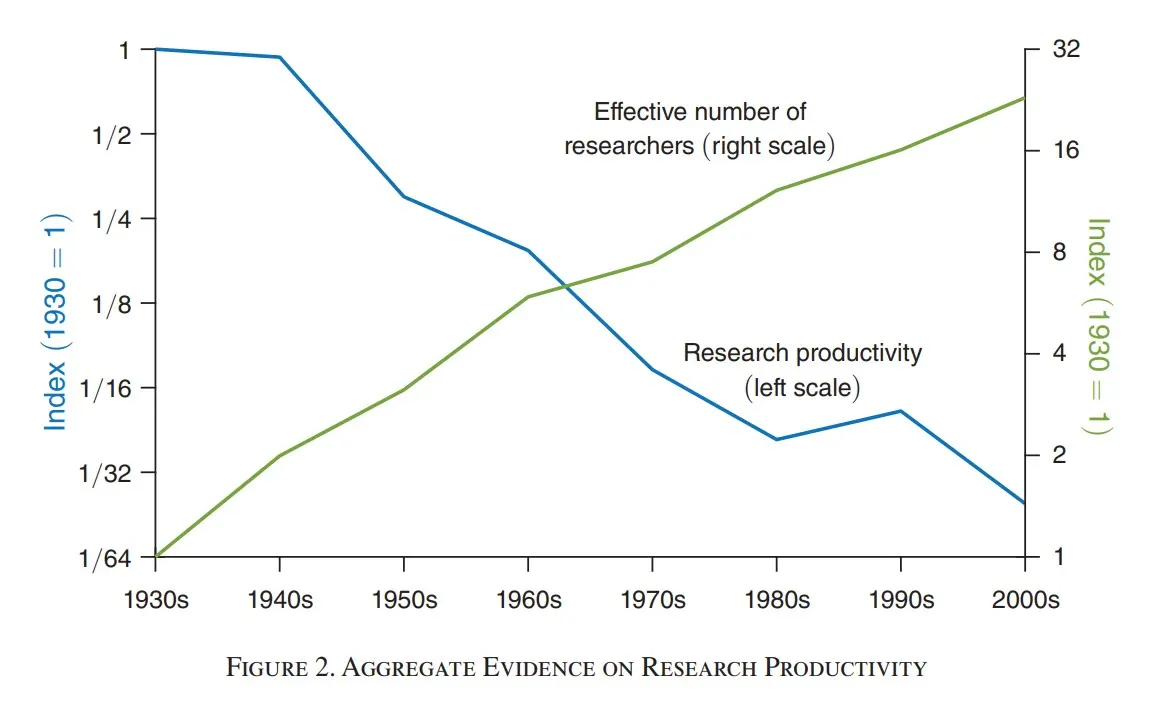
One possible answer is provided by a 2020 paper in the American Economic Review, which highlights a decline in “research productivity,” even as the number of global researchers increases. Significantly, rather than using published articles or citations as a proxy for research productivity, the authors use Total Factor Productivity.
In this methodology, improvements in indicators like crop yield growth per acre in agriculture or years of life saved in medicine are automatically ascribed to research. This is clearly a macro-level approach that ignores other variables that could contribute to advances in these areas. Still, the key takeaway is that universities (along with corporations, entrepreneurs, inventors and other agents of change) are no longer producing enough of the right ideas to drive growth.
Baby steps or quantum leaps?
But what are the right ideas? Romer’s theoretical definitions tend to focus on combining physical resources in valuable new ways, so may not get us very far in this discussion. An alternative might be to look at the ongoing debate in the pages of Nature and other journals about the possible decline in “disruptive innovation” in research. Leveraging a controversial new metric, the Consolidation-Disruption (CD) index, based on evidence from citations and patents, a team from the Universities of Minnesota and Arizona maintains that the frequency of significant advances in the research literature has been declining over time, despite the recent surge in publications. Possible explanations for this shortfall include pressure to publish, university career structures, funding biases and the inherent complexity of modern science. Indeed, some argue that the model of progress has now become incremental, with dispersed groups of specialists displacing isolated polymaths. However, it is unclear whether their cumulative “baby steps” lag behind the “quantum leaps” of the previous age.
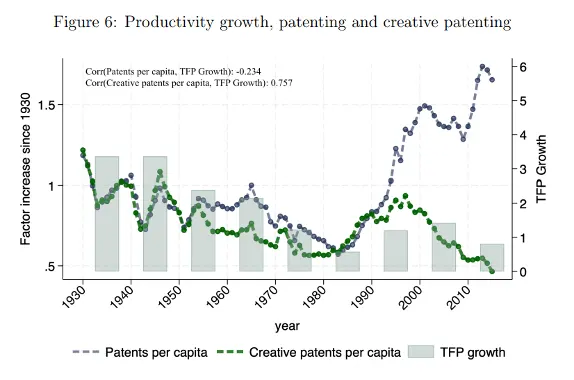
While the evidence is inconclusive, it is striking to see the same themes resurface in recent patent analyses, such as in a 2024 study by Aakash Kalyani of the St. Louis Federal Reserve. Kalyani distinguishes between “creative” and “derivative” patents, with creativity defined as “the share of technical terminology that did not appear in previous patents.” Again, while the overall number of patents has increased, the number of “creative patents” has steadily declined, particularly over the last 25 years. As economists would put it, more patents do not necessarily lead to more productivity.
More or more creative researchers?
While research innovation and research impact are not the same, the similarities in the analyses discussed above indicate a strong connection between the two. The reason for their shared decline is less evident. Economist Daniel Susskind speculates that research may be getting harder because we have now picked all the “low-hanging fruit” (Growth – A Reckoning, Allen Lane 2024). For Susskind, this means we should redouble our efforts, getting even more researchers on the job while slimming down “academic bureaucracies.” The evidence discussed above suggests that simply increasing the number of researchers does not lead to more innovative or economically viable work, although it is important to remember that the value of research is not necessarily connected to its capacity to drive material prosperity. Perhaps what is required is not more researchers, but researchers who are better equipped to see patterns and connections that might otherwise be missed?
Can AI tools drive disruptive thinking?
A more subtle take on the systemic issue is that the modern research ecosystem may be favoring small, safe bets over risky, expensive blue-sky thinking, a point raised by Elsevier’s Adrian Raudaschl, product manager for LeapSpace, in a recent interview. Whatever your stance on the research innovation debate, the potential of AI tools to drive more disruptive thinking is an intriguing new development. While these tools can speed up repetitive tasks and give researchers more time to think creatively, they can also contribute by supporting a far broader frame of reference. To address this need, LeapSpace has been designed to let users explore across the full range of disciplines, providing accessible entry points and allowing them to make connections that might otherwise go unnoticed. Rather than simply providing summaries of abstracts, LeapSpace proactively suggests unexpected or unconventional angles, potentially providing novel lines of inquiry.
This type of approach is particularly well-suited for areas like rare disease research, which can be constrained by the structural barriers discussed above.In the words of Cara O’Neill, Chief Science Officer, Cure Sanfilippo Foundation: “Rare disease research is limited by the small number of experts focused on each disease, Sanfilippo syndrome being no exception. We rely on connections and learnings across multiple disciplines to bridge gaps in direct evidence. Synthesizing vast amounts of often disparate information is a challenge. In my early experience with LeapSpace, I've been impressed with how it's able to address these challenges while providing confidence in the accuracy and rigor of its outputs.”
This ability to bridge disciplines and make new connections is critical at a time when governments and funders, eager to see “real-world impact,” are driving a shift toward more mission-driven research (e.g., tackling grand challenges like curing cancer), a trend noted by 67% of the respondents to the survey underpinning Elsevier’s Researcher of the Future report. In Europe and the US, a parallel trend towards reduced researcher mobility, noted by the same report, and curtailed international collaboration opportunities – the result of rising geopolitical tensions – may also strengthen the case for expansive AI tools.
More novel and ambitious research
While LeapSpace may well accelerate the workflows of its users, the goal is not to create more research, but more novel and ambitious research. The mechanisms via which research ideas confer social or economic benefits are still underexplored, but the capacity of AI tools to help generate ideas that foster growth – in the way defined by Romer and others – raises a tantalizing prospect for research leaders, eager to demonstrate the impact of their institutions. AI is reshaping academia and society – redefining work, changing social structures and raising important questions about ethics, bias and accountability – but one of its most enduring impacts may yet be the rejuvenation of the research enterprise and its reconnection to economic strategies as a recognized engine of development.
What successful AI rollouts have in common
A good AI transformation is a holistic, highly inclusive process in which institutional stakeholders unite behind common goals and a shared governance framework. This is the main takeaway of a comprehensive new article, Developing strategic AI leadership for future-ready universities, which draws on examples from around the world and provides guidance on leading and structuring a coherent AI rollout.
GenAI offers major benefits for research, accelerating discovery and enabling large-scale analysis, but also comes with sustainability challenges. At Elsevier, digital infrastructure makes up ~0.01% of our carbon footprint. GenAI contributes less than 1% of total emissions, and we continue our efforts to reduce its environmental impact.
Addressing the carbon cost of AI
The rapid growth of AI over the last two years has come with a significant environmental cost. While the exact scale of this impact is widely debated (one recent study estimates that the AI boom caused a similar level of CO2 emissions to New York City in 2025), much of the concern focuses on data center energy consumption and the vast resources required to train AI models, particularly Large Language Models (LLMs). All AI providers share a responsibility for these issues and owe it to their users to provide transparency around their own environmental credentials.
Elsevier’s efforts to curb its environmental impact predate the recent boom in AI solutions. The RELX group, Elsevier’s parent company, has maintained an MSCI ESG rating of AAA for the last 9 years. MSCI (Morgan Stanley Capital International) Inc. is a provider of investment decision support tools, and its ESG (Environmental, Social and Governance) data standards have become a de facto industry benchmark for sustainability. The MSCI ESG Rating measures a company’s resilience to long-term, financially relevant environmental, social and governance (ESG) risks. Ranging from AAA (leader) to CCC (laggard), these ratings assess industry-specific risks and management capabilities.
Driving AI standards for academic information
Underlying Elsevier’s AAA rating is a longstanding commitment to reducing its direct emissions, which have fallen by 83% since 2018. Although AI accounts for around a ten-thousandth of the company's current carbon footprint, it remains an area under careful scrutiny. For example, we know that AI-produced video is highly energy-intensive, so we try to avoid using it in our solutions. Moreover, we proactively work with key partners, such as Microsoft Azure and Amazon Web Services, whose data centers are already powered by green electricity, to operate more sustainably.
While global frameworks for AI governance have been slowly emerging, there remains a pressing need for the AI industry to adopt greener practices and consistent sustainability standards. With this in mind, we also partner with other publishers and providers in the academic information space to develop new protocols to govern the environmental profiles of AI tools – much as we helped drive the COUNTER and CrossRef initiatives in the early days of online academic content.
At Elsevier, we are actively working to reduce our carbon impact. We’re committed to being net zero by 2040, if not before. As we invest more heavily in AI, this commitment is mirrored in programs designed to ameliorate the environmental impact of new technology. We believe that if AI is to become a foundational component of higher education, part of the infrastructure that supports research, teaching and administrative work, then we urgently need to tackle sustainability alongside more familiar “risk” areas like academic integrity, bias and a human-centred approach.
AI doesn’t stand still, so neither should AI literacy training
AI literacy training must keep pace with rapidly evolving technologies and professional practice. Developed by the Research Data Management Librarian Academy (RDMLA) with support from Elsevier and Harvard University, AI for Librarians is a new, free course that helps information professionals build practical, modern AI competencies grounded in real library scenarios.
Join the community and receive future editions directly in your inbox
Sign up for our AI in Higher Education newsletter to receive updates on AI-related content, featuring thought-leadership, practical insights, and Elsevier's newest offerings in research and education.