
AI agents in action: From uncertainty to safety in regulatory review
April 21, 2026
By Maaly Nassar

Meet RegBot, the agentic AI platform that can help drug safety officers with their critical work
In regulatory science, the smallest detail can change a drug’s fate. But finding that detail — and acting on it quickly — requires time, expertise, and the ability to navigate evidence scattered across languages and agencies.
This is the daily reality of a regulatory officer — whether at the FDA, EMA, or Japan’s PMDA — where every page of data may carry life-changing weight. To see what that means in practice, step into the shoes of a drug safety officer at either agency.
A peek into the life of a Drug Safety Officer
In the summer of 2002, the cicadas are loud outside your window as you sift through the latest post-marketing safety report for a new lung cancer treatment — gefitinib. Within just four months of approval, spontaneous reports in Japan have already recorded 87 interstitial lung disease (ILD)–related deaths. By January 2003, the tally reached 183. Later mandatory surveillance estimates ILD incidence around 5.8%, with mortality near 2.3% among treated patients. The response is swift: an emergency safety report to clinicians, a package insert revised with stronger warnings, and mandatory all-case surveillance. The urgency grows sharper as a review shows tumor shrinkage, but no clear survival advantage — underscoring that patient safety must come first.
By 2011, another safety signal demands attention. In June, during Tokyo’s rainy season, you arrive with your umbrella dripping by the door to find the first email marked “urgent.” Overseas regulators warn that long-term pioglitazone use may be linked to bladder cancer. You turn immediately to adverse event data and launch a cross-agency review. Within days, an urgent safety advisory is issued, the label updated with new contraindications and monitoring guidance, and clinicians instructed to watch for urinary symptoms — a precaution that remains in place even after later studies find no increased risk.
Years later, in 2026, the focus shifts again as you review post-marketing safety information for semaglutide, an active ingredient approved in FDA-regulated drugs for diabetes and obesity. The adverse effects are familiar and labeled — severe gastrointestinal reactions, delayed gastric emptying, pancreatitis, and gallbladder disease — consistent with GLP-1 receptor agonism. What gives pause is scale: semaglutide is now being used far beyond approved products. Reports increasingly reference non-approved compounded formulations, produced without FDA review, where dose variability, improper storage, and handling complicate safety assessment. As adverse reactions rise, it becomes difficult to distinguish known pharmacological risk from uncertainty introduced by unregulated use. The response is decisive: FDA safety communications warn that compounded semaglutide products have not been evaluated for safety, effectiveness, or quality, and enforcement action follows. Under regulatory scrutiny, non-approved products are withdrawn from the market.
Across more than two decades of regulatory work, these defining moments demand vigilance, judgment, and the resolve to act quickly in the face of uncertainty. For an FDA/PMDA officer, this is not the exception but the rhythm of the job: a life lived at the intersection of data, decisions, and the safety of patients who may never know your name.
A little help, please?
Now imagine if regulatory professionals had an AI assistant that did more than retrieve documents — one that could reason across them. An assistant that understands regulatory context, navigates multiple languages, respects licensing boundaries, and links every conclusion back to its original evidence.
That’s RegBot.
Introducing RegBot: Agentic AI for regulatory science
RegBot is not a translation tool, and it is not a generic chatbot. It is a multilingual, agentic AI platform designed specifically for regulatory science — where evidence must be traceable, decisions defensible, and data usage compliant with licensing and regulatory scope constraints.
RegBot reasons across regulatory documents from multiple agencies, combining licensed PMDA content (used only within the organization’s secure environment) with public FDA materials. Using generative models, semantic search, domain ontologies, and a regulatory knowledge graph, RegBot enables AI agents to support complex, context-specific regulatory questions with full provenance.
Built with generative models, vector search, semantic search, and domain ontologies, RegBot enables:
Multilingual reasoning — select from multiple LLMs (Japanese, English, and others) to query and interpret regulatory documents in their native language.
Integrated provenance tracking — every answer is linked to the exact source sentence or paragraph, ensuring full auditability.
Ontology-driven filtering — refine answers by concepts, metadata fields, and relationship types, using curated vocabularies including Japanese-language terminologies developed for PMDA document annotation.
Cross-agency analysis — compare conclusions from PMDA and FDA reviews side-by-side where the organization holds the appropriate license for PMDA content.
Knowledge graph integration — explore entities, relationships, and metadata within structured regulatory datasets.
Back to the future: How RegBot could have changed the past
History is full of lessons — but what if we could use today’s tools to act sooner in yesterday’s challenges?
By revisiting three pivotal PMDA and FDA cases, we can see where RegBot’s multilingual reasoning, ontology-driven annotation, and cross-document evidence linking could have accelerated regulatory action — not by replacing expert judgment, but by reducing the time and effort required to assemble defensible conclusions.
2002 – Gefitinib (ILD Risk)
With PMDA reviews annotated using SciBite regulatory English and Japanese ontologies — in-house translations of established public ontologies such as MedDRA (adverse events) and ChEMBL (drugs), tailored to the context of pharmaceutical regulatory documents — RegBot could have helped surface domestic ILD safety signals linked to Gefitinib within the organization’s licensed PMDA environment. By comparing Japan’s case frequency to global safety databases, the unusually high incidence could have been flagged sooner, prompting earlier interventions (Figure 1).
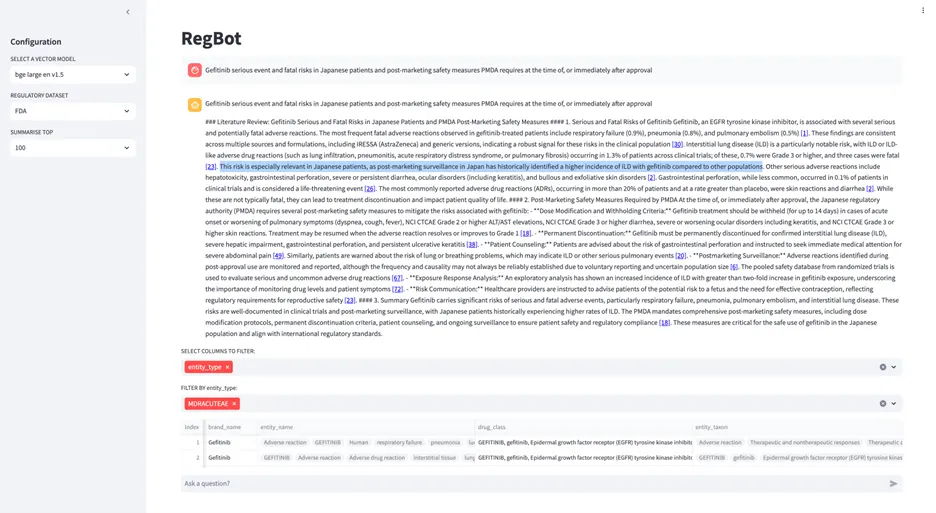
Figure 1: Screenshot from RegBot showing results for Gefitinib, identifying potential serious adverse events and outlining PMDA-required post-marketing safety measures at approval.
2011 – Pioglitazone (Bladder Cancer Risk)
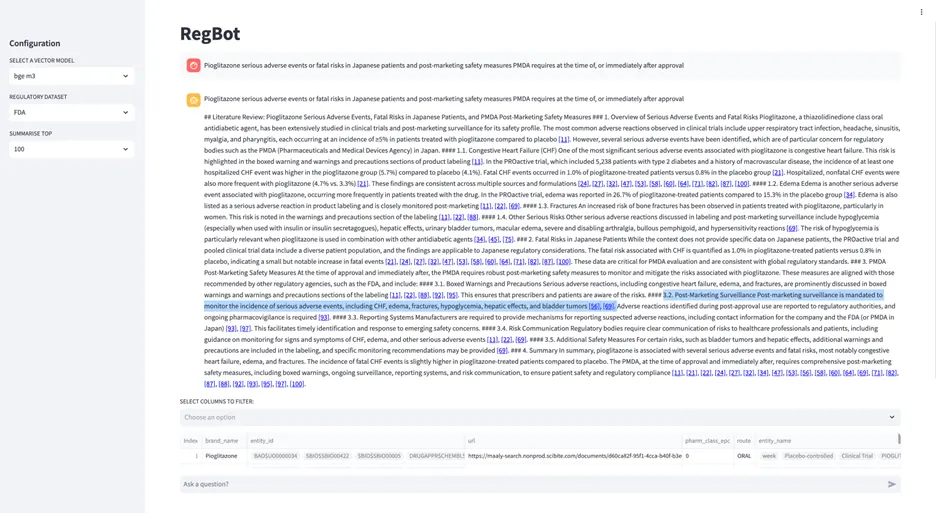
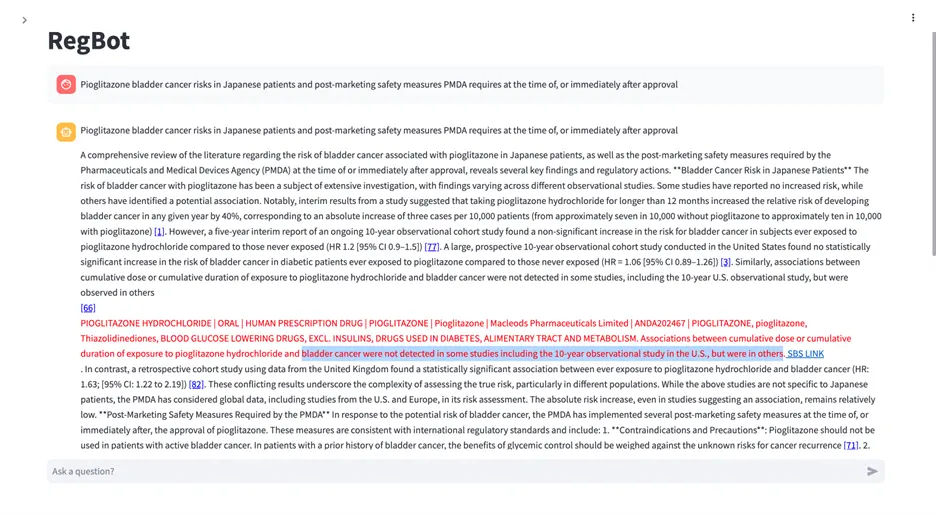
Figure 2: Screenshot from RegBot showing query and results for Pioglitazone, summarizing serious adverse events reported in patients and outlining likely FDA-required post-marketing safety measures, including monitoring for heart failure, bladder cancer, fractures, and other high-risk conditions.
RegBot’s multilingual search would have brought together safety communications from the FDA, harmonizing adverse event terminology through Japanese-English mappings. This would have enabled PMDA reviewers to instantly cross-check global findings with local adverse event data, accelerating label updates.
Those historical cases demonstrate how multilingual insight could have accelerated safety responses. Today, RegBot delivers that capability from the moment a therapy is approved.
2026 – Semaglutide (Compounded formulations and unapproved use risk)
RegBot’s agentic reasoning would have brought together FDA regulatory reviews, clinical trial data, post-marketing safety reports, and non-clinical toxicology for semaglutide — surfacing known dose-related and potentially fatal adverse effects already described in the evidence base.
By linking adverse outcomes to exposure levels and study context, RegBot makes explicit how deviations in formulation, dosing, or handling — such as those introduced through non-approved compounded products — can amplify established risks.
For regulatory teams, this connected view supports earlier recognition of when real-world use drifts beyond approved conditions, enabling timely label clarification, sponsor engagement, and enforcement decisions grounded in precedent.
Today, RegBot delivers that visibility at the moment formulation and dosing questions arise.
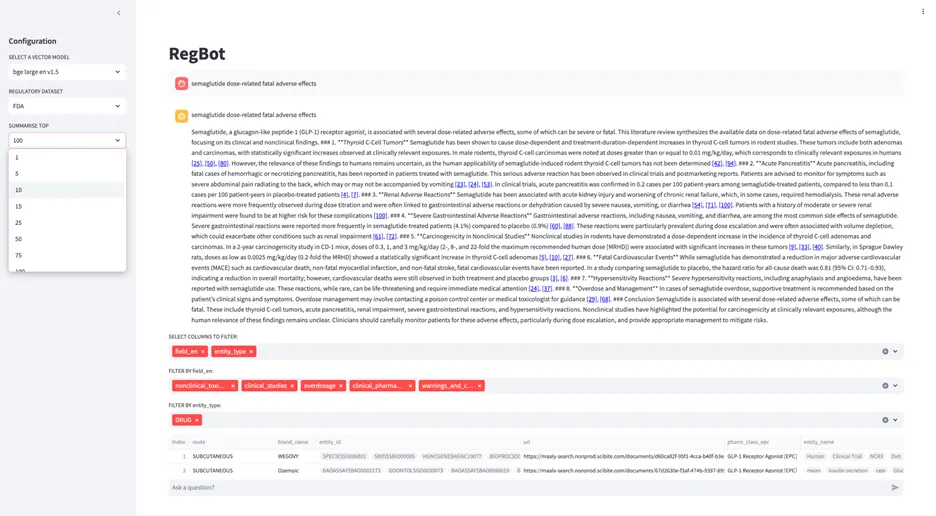
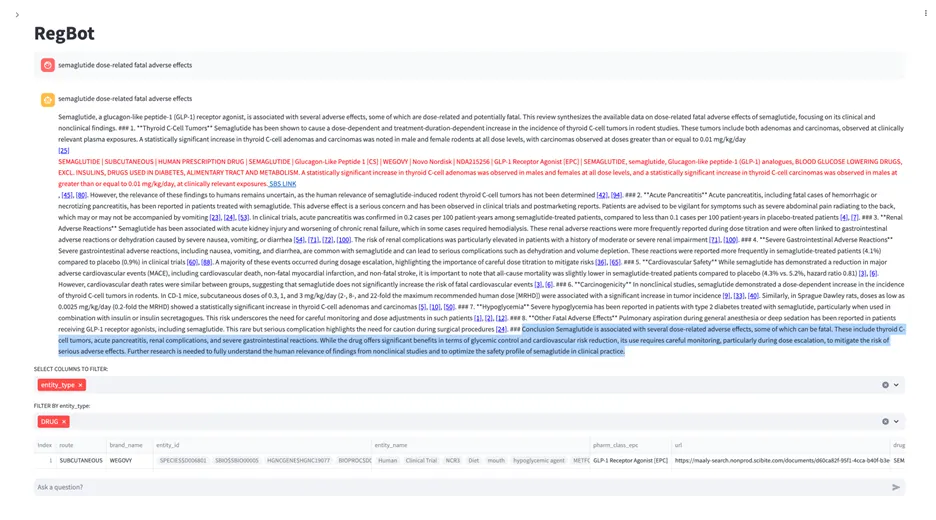
Figure 3: RegBot view of dose-related adverse effects for Semaglutide, integrating clinical, post-marketing, and non-clinical evidence to surface safety risks linked to exposure and dosing context.
The RegBot pipeline
RegBot’s architecture is designed to support inspection-ready regulatory reasoning, combining semantic annotation, knowledge graphs, and agentic AI to ensure that every conclusion can be traced back to licensed source evidence.

Figure 4: RegBot Agentic AI Architecture: Regulatory documents from agencies such as FDA, PMDA, EMA are annotated with English and Japanese regulatory ontologies using SciBite Search. The annotated data is vectorized (by Hugging Face, AWS vector models) and integrated into a knowledge graph. An LLM-powered agent (OpenAI + Neo4j) then performs vector search and reasoning, enabling a chatbot interface for complex regulatory queries.
Data Ingestion – Regulatory reviews from the FDA are ingested directly. PMDA and other licensed-agency content are ingested only where the organization itself holds the necessary license, and only within that organization’s secure environment.
Annotation & Structuring – SciBite Search applies Japanese and English vocabularies to identify drugs, targets, adverse events, endpoints, and more.
Vectorization & Knowledge Graph – Annotated text is vectorized for semantic search, and key entities/relationships are stored in a knowledge graph for cross-document reasoning.
Agentic AI Reasoning – RegBot’s agentic layer uses LLMs to retrieve and reason over multiple documents, applying step-by-step regulatory logic to answer complex queries.
Multilingual Model Selection – Users can select from different multilingual generative models to suit their task (e.g., Japanese PMDA review analysis, FDA–PMDA comparison).
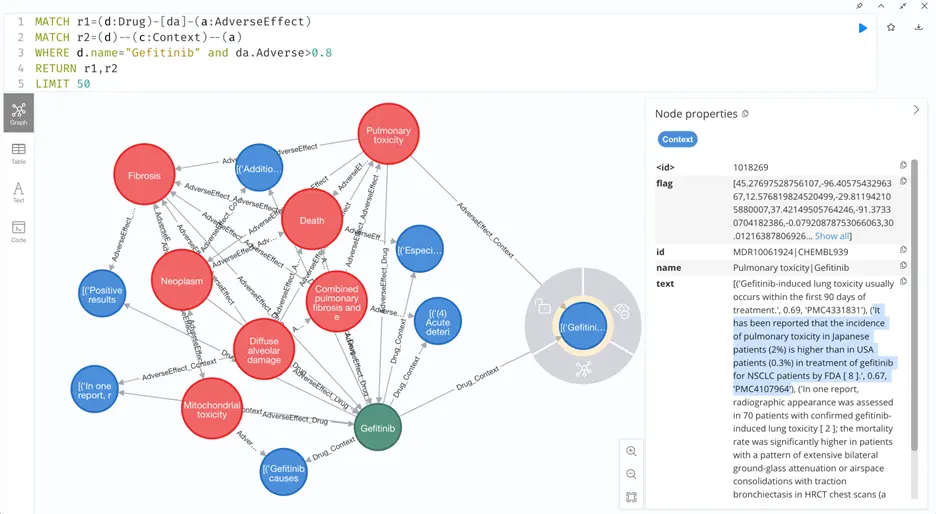
Figure 5: RegBot knowledge graph: AI-generated adverse relationship scores surface the most serious adverse events for Gefitinib (e.g., higher pulmonary toxicity in Japanese patients), by filtering high-confidence links (>0.8).
Collaboration with Tanabe Pharma
Tanabe Pharma Corporation worked with us to deploy RegBot on their secure internal servers. This allowed the regulatory science team in safety research laboratories to explore complex, multilingual questions with complete data provenance, while keeping sensitive content compliant with licensing requirements:
“During the regulatory review process, sponsors are required to respond to questions from regulatory agencies within tight timelines and with clear, evidence-based logic. SciBite's RegBot enabled us to comprehensively extract relevant toxicological precedents from the vast body of regulatory review text for previously approved drugs. RegBot is built on an AI-powered knowledge graph, populated through semantic annotation using SciBite's scientific ontologies and SciBite Search. This foundation allowed us to analyze regulatory review content in a structured and traceable manner. In addition to identifying similar historical cases through large language model–based vector search (RAG), RegBot's ontology-driven filtering capabilities enabled us to precisely isolate the information required to construct a robust toxicological rationale, with a high degree of accuracy. By analyzing this well-grounded knowledge, we are able to produce regulatory documents with strong explainability and confidence, supported by evidence from clinical trials. We hope that SciBite's RegBot will serve as an internal knowledge management platform throughout our drug development and regulatory review processes.”
From historical challenges to modern solutions
The historical PMDA cases show how rapidly evolving evidence, multinational data, and language barriers can complicate regulatory decision-making. RegBot does not replace the expertise of regulators — it empowers them. By bringing together multilingual retrieval, semantic annotation, and agentic reasoning, RegBot reduces the time and effort needed to connect the dots, helping professionals act with clarity and confidence.
Learn more about how SciBite can support your research here.
Related Articles:
AI agents in action: Uncovering our inner mutants
Drug safety and personalized medicine: a vital connection
Harnessing ontologies for pharma: Dr Jane Lomax on the synergy of AI and scientific expertise
Contributor

Maaly Nassar
Senior Data Scientist
SciBite