
New evidence confirms patients with severe psoriasis are at a higher risk for heart disease
Philadelphia | 20 de septiembre de 2023
Research results published in the Journal of Investigative Dermatology uncover decreased coronary flow in patients with severe psoriasis
In the largest study to date exploring the relationship between severe psoriasis and coronary microvascular dysfunction, researchers have found further evidence that patients with severe psoriasis are at higher cardiovascular risk. The resultsopens in new tab/window are published in the Journal of Investigative Dermatologyopens in new tab/window, published by Elsevier.
Psoriasis is a chronic systemic immune-mediated inflammatory disease that affects 1-3% of the global population. In this study, a total of 503 patients with psoriasis, and without clinical cardiovascular disease, underwent transthoracic Doppler echocardiography to evaluate coronary microcirculation. Investigators uncovered a high prevalence of coronary microvascular dysfunction in more than 30% of asymptomatic patients within the study population.
Lead investigator Stefano Piaserico, MD, PhD, Dermatology Unit, Department of Medicine, University of Padova, explained, "Previous studies have shown that patients with severe psoriasis have an increased cardiovascular morbidity and mortality. However, there has been limited research on the specific mechanisms underlying this increased risk, particularly regarding coronary microvascular dysfunction. We wanted to further investigate the prevalence of coronary microvascular dysfunction, as assessed by coronary flow reserve (CFR), in a large cohort of patients with severe psoriasis and its association with psoriasis severity and duration, as well as other patient characteristics. Patients with a reduced CFR underwent angio-CT to exclude a stenosis of the coronary arteries, and no patients showed coronary artery disease. Therefore, all patients with an impaired CFR in our cohort were affected by coronary microvascular dysfunction.”
The study revealed that psoriasis severity, assessed by the Psoriasis Area Severity Index (PASI) score, and the duration of the disease were independently associated with lower CFR, along with the presence of psoriatic arthritis. Furthermore, results from the study showed that conventional cardiovascular risk factors, such as tobacco use, hyperlipidemia, and diabetes mellitus, were not independently associated with reduced CFR in patients with severe psoriasis. These findings emphasize the importance of considering inflammation and psoriasis-related factors in assessing cardiovascular risk in patients with severe psoriasis.
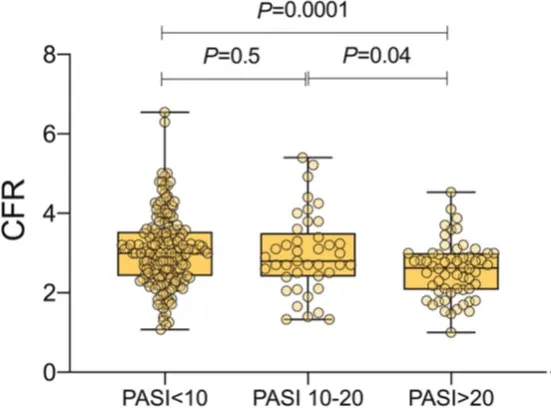
Caption: Boxplot illustrating coronary flow reserve (CFR) values according to severity of psoriasis: PASI < 10 (moderate), PASI 10e20 (severe), PASI > 20 (very severe) (Credit: Journal of Investigative Dermatology).
The findings shed light on the potential mechanism by which psoriasis increases the risk of cardiovascular complications in affected individuals, in agreement with previous studies on chronic inflammatory conditions, such as rheumatoid arthritis, systemic lupus erythematosus and systemic sclerosis. The study supports the role of systemic inflammation in the development of coronary microvascular dysfunction.
Dr. Piaserico commented, "We should diagnose and actively search for microvascular dysfunction in patients with psoriasis, as this population is at particularly high risk. We might hypothesize that an early and effective treatment of psoriasis would restore the dysfunction and eventually prevent the future risk of myocardial infarction and heart failure associated with it. In keeping with this, some preliminary studies showed that coronary microvascular dysfunction is restored after a treatment with biologics. Nevertheless, prospective studies are needed to confirm whether these findings translate into reductions in cardiovascular events."
---
Notes for editors
The article is “Coronary Microvascular Dysfunction in Asymptomatic Patients with Severe Psoriasis,” by Stefano Piaserico, Evangelia Papadavid, Annagrazia Cecere, Gloria Orlando, Konstantrinos Theodoropoulos, Pelagia Katsimbri, George Makavos, Penelope Rafouli-Stergiou, Sabino Iliceto, Mauro Alaibac, Francesco Tona, and Ignatios Ikonomidis (https://doi-org.ucc.idm.oclc.org/10.1016/j.jid.2023.02.037opens in new tab/window). It appears online in advance of the Journal of Investigative Dermatology, volume 143, issue 10(October 2023), published by Elsevier.
The article is openly available for 30 days at https://www.jidonline.org/article/S0022-202X(23)01955-3/fulltextopens in new tab/window.
The full text of the article is also available to credentialed journalists upon request; contact Theresa Monturano at +1 215 239 3711 or [email protected]opens in new tab/window. Journalists wishing to interview the authors should contact Stefano Piaserico, MD, PhD, at [email protected]opens in new tab/window.
About Journal of Investigative Dermatology
The Journal of Investigative Dermatologyopens in new tab/window (JID) is the official journal of the Society of Investigative Dermatology and the European Society for Dermatological Research. JID publishes high impact reports describing original research related to all aspects of cutaneous biology and skin diseases. Descriptions of important findings that result from basic, translational, or clinical research are published. Clinical research can include, but is not limited to, interventional trials, genetics studies, epidemiology, and health services research. www.jidonline.orgopens in new tab/window
Acerca de Elsevier
Elsevier es líder global en información avanzada y soporte para la toma de decisiones. Durante más de un siglo, ha ayudado a avanzar la ciencia y la salud para promover el progreso humano. Apoya a comunidades de investigación académicas y corporativas, médicos, enfermeras, futuros profesionales de la salud y educadores en 170 países, proporcionándoles conocimientos críticos y soluciones innovadoras que combinan contenido científico y médico confiable con tecnologías de IA de vanguardia. Elsevier promueve la inclusión y la sostenibilidad incorporando estos valores en sus productos y cultura. La Elsevier Foundation respalda investigaciones y asociaciones de salud alrededor del mundo.
Elsevier forma parte de RELX, proveedor global de herramientas de análisis y decisión basadas en información para clientes profesionales y de negocios. Para más información, visite www.elsevier.com y síganos en redes sociales: @ElsevierConnect.
Media contact
TM