
New research shows potential to reduce pain in women suffering from endometriosis
Philadelphia | 3 de agosto de 2023
Investigators reporting in The American Journal of Pathology have found evidence that neurotrophins and their receptors are novel therapeutic targets for pelvic pain in endometriosis
Pelvic pain in women with endometriosis is attributed to neuroinflammation. Researchers investigated biochemical mediators of endometriosis-associated pelvic pain to provide a foundation to identify new drugs to improve symptoms and quality of life. They postulated that novel therapeutic targets for pelvic pain in endometriosis are regulated by interleukin-1β (IL-1β) via the c-Jun N-terminal kinase (JNK) signaling pathway. IL-1β has been a popular focus of translational research in the field of endometriosis. Their resultsopens in new tab/window are published in The American Journal of Pathologyopens in new tab/window published by Elsevier.
Lead investigator Robert N. Taylor, MD, PhD, Departments of Obstetrics and Gynecology and of Pathology and Anatomical Sciences, Jacobs School of Medicine and Biomedical Sciences, University at Buffalo, explains, “Endometriosis is common and complex and likely to develop via multiple etiological mechanisms. As a result, multiple therapeutic targets are needed. Strategies over the past five decades have focused on surgical and endocrine approaches. New drugs aimed to block neuroinflammation may be promising future interventions for endometriosis-associated pain.”
This collaborative research effort sought to identify biochemical mediators of endometriosis-associated pelvic pain using established neural biomarkers isolated from endometrial tissue biopsies obtained from eight adult women undergoing hysterectomy (four patients with endometriosis; four without). Immunofluorescence histochemistry confirmed the presence of neurons in human endometrial tissue, and isolated endometrial stromal cells (ESCs) expressed neurotrophins and their receptors. Peritoneal fluid samples were analyzed from 14 participants with and 26 participants without endometriosis.
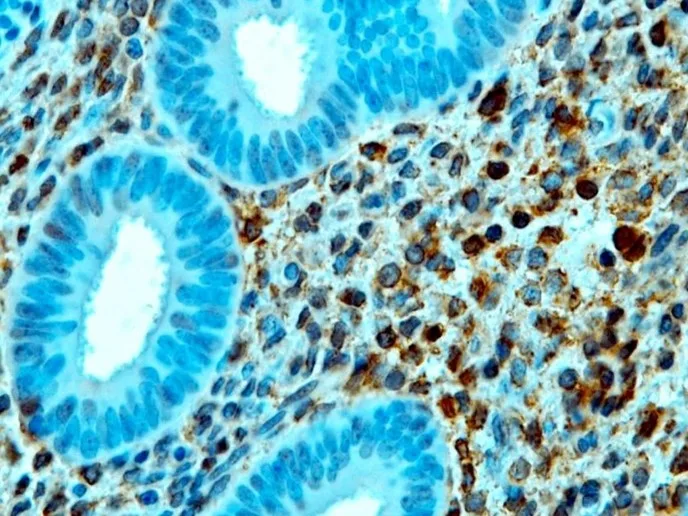
Caption: Immunoperoxidase histochemistry was used to localize brain-derived neurotrophic factor in the endometrium, which resulted in a predominant stromal cytoplasmic signal (Credit: The American Journal of Pathology).
Tropomyosin receptor kinase A/B (TrkA/B) expression in stimulated ESCs was almost twice as high in endometriosis cases than ESCs from control subjects, an effect mediated via the c-Jun N-terminal kinase (JNK) pathway. Investigators therefore postulate that JNK inhibitors have the potential to reduce neuroinflammation in women with endometriosis.
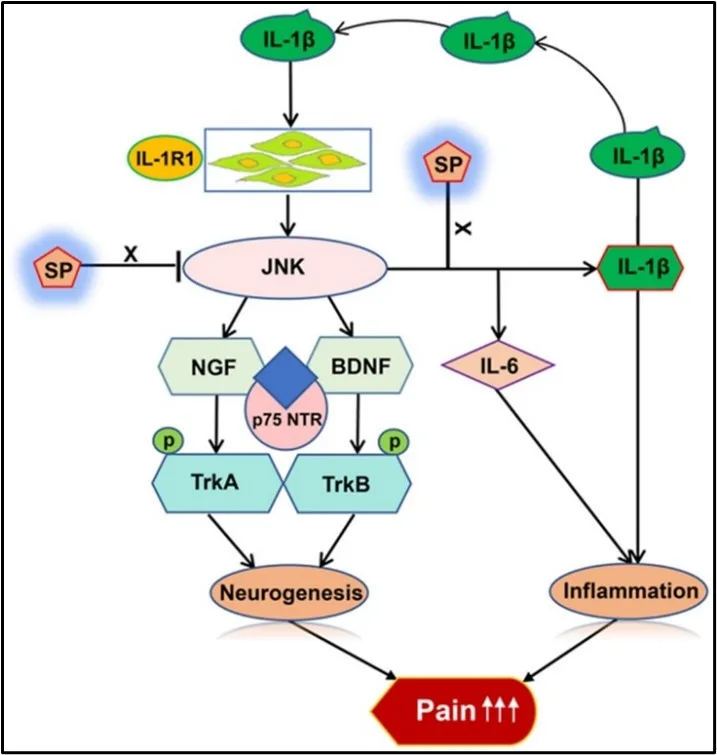
Caption: Diagram of neuroinflammation in endometriosis. Researchers propose that IL-1β activates IL-1 type 1 membrane receptor (IL-1R1) in endometrial stromal cells, predominantly via the c-Jun N-terminal kinase (JNK) pathway, to promote neurotrophin and neurotrophin receptor (NTR) production and signaling, which in turn activate neurogenesis and pain. Parallel pathways promote IL-6 production and IL-1β autoregulation, potentially creating a vicious cycle of inflammation and pelvic pain. BDNF, brain-derived neurotrophic factor; NGF, nerve growth factor; SP, SP600125; TrkA/B, tropomyosin receptor kinase A/B (Credit: The American Journal of Pathology).
Nerve fibers were identified in the human uterus more than 80 years ago, but only in the past decade has their association with endometriosis pain been appreciated. The main findings of this study are that despite functioning through at least five different post-receptor signal cascades, the IL-1β pathway in ESC that engages JNK regulates a coordinated program of neurogenic factors, their receptors and other related nerve proteins that investigators identified in the uterus and ectopic lesions of women with endometriosis. They also found that JNK inhibitors may have the potential to reduce neuroinflammation in women with endometriosis.
The results revealed that many of the dominant mediators of inflammation, nerve growth, and pain sensation are predominantly communicated via a selective signaling node of the JNK pathway. The most significant implication of this finding is the potential for drugs targeting that common pathway to impact and ameliorate the multifaceted aspects of endometriosis-associated pelvic pain.
Dr. Taylor comments, “Our research and that of others lay a foundation to identify new drugs to block painful stimuli emanating from the pelvis to the brain, opening opportunities to improve symptoms and quality of life in women not well served by the limited therapeutics currently available. Drugs of the future that target JNK specifically, but do not interfere with ovarian hormone production, might supplant current hormone-disrupting agents, many of which have adverse side effect profiles.”
Endometriosis is a disease in which tissue similar to the lining of the uterus grows outside the uterus. It can cause severe pain in the pelvis and infertility. It affects 5% to 10% of women of reproductive age worldwide.
---
Notes for editors
The article is “Neurotrophins and Their Receptors, Novel Therapeutic Targets for Pelvic Pain in Endometriosis, Are Coordinately Regulated by IL-1β via the JNK Signaling Pathway,” by Jie Yu, Sarah L. Berga, Eric Zou, Andrew D. Schrepf, Daniel J. Clauw, Sawsan As-Sanie, and Robert N. Taylor (https://doi-org.ucc.idm.oclc.org/10.1016/j.ajpath.2023.04.007opens in new tab/window). It appears in The American Journal of Pathology, volume 193, issue 8 (August 2023), published by Elsevier.
The article is openly available at https://ajp.amjpathol.org/article/S0002-9440(23)00164-5/fulltextopens in new tab/window.
Supported by Eunice Kennedy Shriver National Institute of Child Health and Human Development grant R01 HD088712.
Full text of the article is also available to credentialed journalists upon request. Contact Eileen Leahy at +1 732 238 3628 or [email protected]opens in new tab/window to request a PDF of the article. To request an interview with the authors please contact Ellen Goldbaum, Media Relations, Jacobs School of Medicine and Biomedical Sciences, University at Buffalo, at +1 716 771 9255 or [email protected]opens in new tab/window.
About The American Journal of Pathology
The American Journal of Pathologyopens in new tab/window, official journal of the American Society for Investigative Pathologyopens in new tab/window, published by Elsevier, seeks high-quality original research reports, reviews, and commentaries related to the molecular and cellular basis of disease. The editors will consider basic, translational, and clinical investigations that directly address mechanisms of pathogenesis or provide a foundation for future mechanistic inquiries. Examples of such foundational investigations include data mining, identification of biomarkers, molecular pathology, and discovery research. High priority is given to studies of human disease and relevant experimental models using molecular, cellular, and organismal approaches. https://ajp.amjpathol.orgopens in new tab/window
Acerca de Elsevier
Elsevier es líder global en información avanzada y soporte para la toma de decisiones. Durante más de un siglo, ha ayudado a avanzar la ciencia y la salud para promover el progreso humano. Apoya a comunidades de investigación académicas y corporativas, médicos, enfermeras, futuros profesionales de la salud y educadores en 170 países, proporcionándoles conocimientos críticos y soluciones innovadoras que combinan contenido científico y médico confiable con tecnologías de IA de vanguardia. Elsevier promueve la inclusión y la sostenibilidad incorporando estos valores en sus productos y cultura. La Elsevier Foundation respalda investigaciones y asociaciones de salud alrededor del mundo.
Elsevier forma parte de RELX, proveedor global de herramientas de análisis y decisión basadas en información para clientes profesionales y de negocios. Para más información, visite www.elsevier.com y síganos en redes sociales: @ElsevierConnect.
Contacto
EL
CCP
Chhavi Chauhan, PhD
Director of Scientific Outreach
The American Journal of Pathology
+1 240 283 9724
Correo electrónico Chhavi Chauhan, PhD