
Smokeless tobacco and cigarettes confer similar adverse vascular health risks
Ann Arbor | 22 de marzo de 2023
Like smoking, using smokeless tobacco products puts adults at twice the risk for developing peripheral artery disease compared to those who don’t use either, investigators report in the American Journal of Preventive Medicine
A new studyopens in new tab/window in the American Journal of Preventive Medicineopens in new tab/window, published by Elsevier, investigated the incidence of peripheral artery disease (PAD) among users of smokeless tobacco products. The findings show that the use of chewing tobacco and snuff is associated with a two-fold increase in the risk for PAD.
“We’ve long known about the link between cigarette smoking and cardiovascular disease and PAD. There is much less information available about the harmful effects of noncombustible forms of tobacco and nicotine exposure. Building on prior research associating smokeless tobacco use with heart disease and stroke, our results link use of these products to a higher incidence of PAD,” explained lead investigator Jeremy R. Van’t Hof, MD, MS, Lillehei Heart Institute & Cardiovascular Division, Department of Medicine, University of Minnesota Medical School, Minneapolis, MN, USA.
The investigators evaluated data from 14,344 participants in the Atherosclerosis Risk in Communities (ARIC) Study, which has followed adults in United States since the late 1980s. The average age of participants at the beginning of study was 54.1, 54.8% were female, and 26.4% were Black.
The research characterized adults by smokeless tobacco use and cigarette smoking and then analyzed who developed PAD by identifying hospitalizations with diagnosis codes for PAD or leg revascularization. After adjusting for sociodemographic and cardiovascular risk factors, smokeless tobacco use was associated with a two-fold increased risk for PAD. This increased risk was only seen in individuals who were not currently smoking at the beginning of the study.
The rate of PAD diagnoses was 4.4 per 1,000 person years among the smokeless tobacco users and 3.4 per 1,000 person years for current cigarette smokers. In comparison, there were only 1.3 cases of PAD per 1,000 person years for individuals who had never used smokeless tobacco products and were not currently smoking cigarettes. Notably, there was no incremental increase in risk for participants who used smokeless tobacco and also smoked cigarettes. This may be because the risk of PAD from cigarette smoking is strong enough that adding an additional tobacco exposure did little to adjust that risk.
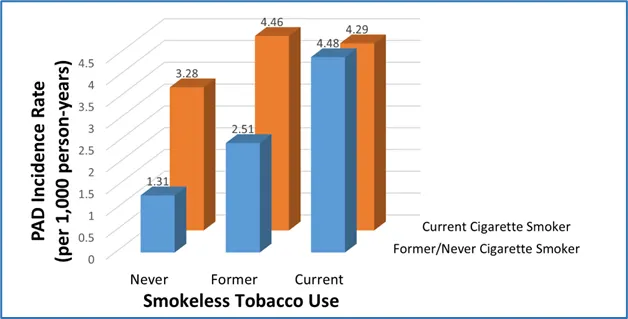
Incidence rate for peripheral artery disease (PAD) associated with the use of smokeless tobacco at baseline, 1987−2018 (Credit: American Journal of Preventive Medicine).
Public health efforts have successfully reduced cigarette smoking in the US over the past 30 years, but smokeless tobacco use is on the rise, with 2.4% of adults reporting use of smokeless tobacco products in 2019. Noncombustible tobacco products are often viewed as “clean” nicotine delivery systems and considered less harmful than cigarettes, leading some to advocate for their use in smoking cessation. “While smokeless tobacco products may not expose people to the noxious effects of combustion, our study shows that they nonetheless have an adverse impact on vascular health. It is important for clinicians to understand these health implications, screen patients for all forms of tobacco and nicotine use, and counsel accordingly,” Dr. Van’t Hof advised. Noting that uncertainty remains about the net benefit versus harm of vaping, he explained that the study did not evaluate e-cigarettes because the baseline ARIC data was collected before they were introduced.
---
Notes for editors
The article is “Association of Smokeless Tobacco Use With Incident Peripheral Artery Disease: Results From the Atherosclerotic Risk in Communities Study,” by Jeremy R. Van’t Hof, MD, MS, Wendy Wang, MPH, Kunihiro Matsushita, MD, PhD, Gerardo Heiss, MD, PhD, Aaron R. Folsom, MD, MPH, Rachel Widome, PhD, and Pamela L. Lutsey, PhD (https://doi-org.ucc.idm.oclc.org/10.1016/j.amepre.2023.01.001opens in new tab/window). It appears online in advance of the American Journal of Preventive Medicine, volume 64, issue 5 (May 2023), published by Elsevier. The article is openly available for 30 days at https://www.ajpmonline.org/article/S0749-3797(23)00002-8/fulltextopens in new tab/window. Full text of this article is also available to credentialed journalists upon request; contact Jillian B. Morgan at +1 734 936 1590 or [email protected]opens in new tab/window. Journalists wishing to interview the authors should contact Media Relations, University of Minnesota Medical School, at [email protected]opens in new tab/window. The research was supported by the National Heart, Lung, and Blood Institute, National Institutes of Health, Department of Health and Human Services under contract 75N92022D00003.
About the American Journal of Preventive Medicine
The American Journal of Preventive Medicineopens in new tab/window is the official journal of the American College of Preventive Medicineopens in new tab/window and the Association for Prevention Teaching and Researchopens in new tab/window. It publishes articles in the areas of prevention research, teaching, practice and policy. Original research is published on interventions aimed at the prevention of chronic and acute disease and the promotion of individual and community health. The journal features papers that address the primary and secondary prevention of important clinical, behavioral and public health issues such as injury and violence, infectious disease, women's health, smoking, sedentary behaviors and physical activity, nutrition, diabetes, obesity, and alcohol and drug abuse. Papers also address educational initiatives aimed at improving the ability of health professionals to provide effective clinical prevention and public health services. The journal also publishes official policy statements from the two co-sponsoring organizations, health services research pertinent to prevention and public health, review articles, media reviews, and editorials.
Acerca de Elsevier
Elsevier es líder global en información avanzada y soporte para la toma de decisiones. Durante más de un siglo, ha ayudado a avanzar la ciencia y la salud para promover el progreso humano. Apoya a comunidades de investigación académicas y corporativas, médicos, enfermeras, futuros profesionales de la salud y educadores en 170 países, proporcionándoles conocimientos críticos y soluciones innovadoras que combinan contenido científico y médico confiable con tecnologías de IA de vanguardia. Elsevier promueve la inclusión y la sostenibilidad incorporando estos valores en sus productos y cultura. La Elsevier Foundation respalda investigaciones y asociaciones de salud alrededor del mundo.
Elsevier forma parte de RELX, proveedor global de herramientas de análisis y decisión basadas en información para clientes profesionales y de negocios. Para más información, visite www.elsevier.com y síganos en redes sociales: @ElsevierConnect.
Contacto
JBM