
Three US regions hit the hardest by deaths of despair since 2010
Ann Arbor | 26 de abril de 2023
Co-occurring clusters of suicide, overdose, and liver disease mortalities identified in the US west, southeast, and Appalachia/rust belt, report investigators in the American Journal of Preventive Medicine
A new studyopens in new tab/window in the American Journal of Preventive Medicineopens in new tab/window, published by Elsevier, identified three overlapping clusters of deaths of despair (i.e., suicide, overdose, and chronic liver disease and cirrhosis deaths) across the United States since 2010. Noting the sharp increase in deaths of despair documented in recent years, the investigators analyzed mortality data for individuals 10 years of age or older from 2000-2019 to detect geographic and temporal patterns. The findings showed six suicide clusters, four overdose clusters, nine alcohol-related liver disease clusters, which coincided in three large areas of the US west, southeast, and Appalachia/rust belt.
“Knowledge of geographic areas where suicide, overdose, and liver disease deaths are higher than expected, and where they coincide over multiple years, can help identify persistent clusters of deaths of despair that warrant public health intervention and continued or enhanced surveillance. Understanding which communities are at risk for co-occurring deaths of despair can assist public health entities to advocate for resources and funding to address the burden of mortality,” explained lead investigator Danielle L. Steelesmith, PhD, Center for Suicide Prevention and Research, The Abigail Wexner Research Institute at Nationwide Children’s Hospital, Columbus, OH, USA.
Overall, mortality rates in the US have been increasing since hitting an all-time low in 2014. Life expectancy stopped trending upward in this period. These developments correspond with the surge in deaths of despair, which increased from 22.7 to 45.8 per 100,000 persons from 2000 to 2017. Overdoses increased the most, but suicides and liver deaths were also on the rise.
Little research has examined how the different categories of deaths of despair map out geographically and within specific timeframes. This project is the first to employ the relatively new and innovative methodology of co-occurring clusters to better understand how the different components interact and cluster together. The clusters identified for each type of death align with the times and places noted in prior research. When the specific clusters were mapped out together, three large intersecting areas stood out, in the west (counties in Wyoming, Montana, Colorado, Idaho, Utah, and New Mexico), southeast (counties in Florida, Georgia, South Carolina, North Carolina, Mississippi, Alabama, Louisiana, Tennessee, Kentucky, and Illinois) and throughout Appalachia/rust belt regions (counties in West Virginia, Virginia, Ohio, Indiana, Michigan, Delaware, Maryland, Pennsylvania, and western New York).
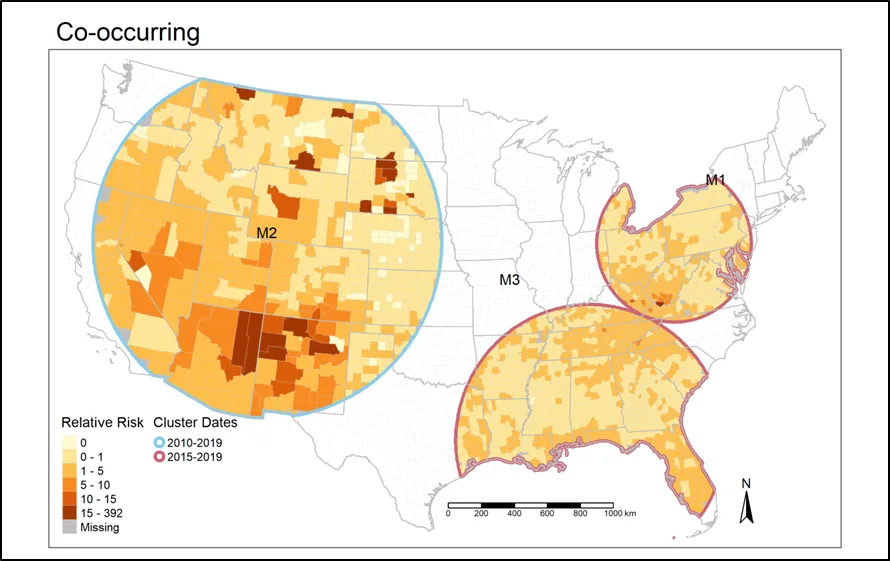
Caption: County relative risk and geographic location of space-time co-occurring clusters of deaths of despair in the United States, 2000-2019 (Credit: American Journal of Preventive Medicine).
“Our findings highlight specific regions and counties at increased risk for these deaths that can be analyzed further to improve our understanding of why deaths of despair have been increasing. In addition, we identified certain areas of concern outside of the co-occurring clusters, such as growing suicide rates in Maine, New Hampshire, and Vermont, an excess of liver disease deaths in Rhode Island, and alarming number of overdoses in eastern Oklahoma. These regions would benefit from more targeted interventions and prevention efforts,” added Dr. Steelesmith.
---
Notes for editors
The article is“Spatiotemporal Patterns of Deaths of Despair across the U.S., 2000 to 2019,” by Danielle L. Steelesmith, PhD, Megan R. Lindstrom, PhD, Huyen T.K. Le, PhD, Elisabeth D. Root, PhD, John V. Campo, MD, and Cynthia A. Fontanella, PhD (https://doi-org.ucc.idm.oclc.org/10.1016/j.amepre.2023.02.020opens in new tab/window). It appears online in advance of the American Journal of Preventive Medicine, volume 65, issue 2 (August 2023), published by Elsevier.
The article is openly available for 30 days at https://www.ajpmonline.org/article/S0749-3797(23)00093-4/fulltextopens in new tab/window.
Full text of this article is also available to credentialed journalists upon request; contact Jillian B. Morgan at +1 734 936 1590 or [email protected]opens in new tab/window. Journalists wishing to interview the authors should contact +1 614 355 0495 or [email protected]opens in new tab/window.
About the American Journal of Preventive Medicine
The American Journal of Preventive Medicineopens in new tab/window is the official journal of the American College of Preventive Medicineopens in new tab/window and the Association for Prevention Teaching and Researchopens in new tab/window. It publishes articles in the areas of prevention research, teaching, practice and policy. Original research is published on interventions aimed at the prevention of chronic and acute disease and the promotion of individual and community health. The journal features papers that address the primary and secondary prevention of important clinical, behavioral and public health issues such as injury and violence, infectious disease, women's health, smoking, sedentary behaviors and physical activity, nutrition, diabetes, obesity, and alcohol and drug abuse. Papers also address educational initiatives aimed at improving the ability of health professionals to provide effective clinical prevention and public health services. The journal also publishes official policy statements from the two co-sponsoring organizations, health services research pertinent to prevention and public health, review articles, media reviews, and editorials. www.ajpmonline.orgopens in new tab/window
Acerca de Elsevier
Elsevier es líder global en información avanzada y soporte para la toma de decisiones. Durante más de un siglo, ha ayudado a avanzar la ciencia y la salud para promover el progreso humano. Apoya a comunidades de investigación académicas y corporativas, médicos, enfermeras, futuros profesionales de la salud y educadores en 170 países, proporcionándoles conocimientos críticos y soluciones innovadoras que combinan contenido científico y médico confiable con tecnologías de IA de vanguardia. Elsevier promueve la inclusión y la sostenibilidad incorporando estos valores en sus productos y cultura. La Elsevier Foundation respalda investigaciones y asociaciones de salud alrededor del mundo.
Elsevier forma parte de RELX, proveedor global de herramientas de análisis y decisión basadas en información para clientes profesionales y de negocios. Para más información, visite www.elsevier.com y síganos en redes sociales: @ElsevierConnect.
Contacto
JBM